
Last Updated: October 23, 2026
Quick Summary
PPF on exotic cars is a clear, self-healing urethane layer bonded to the bodywork that absorbs rock chips, road debris, and UV exposure before they reach the factory paint. Because factory paint is a one-time asset, film preserves originality, which buyers and inspectors pay for at resale. Quality film typically lasts 5 to 10 years with proper care.
- Damage concentrates on the front bumper, hood leading edge, mirrors, A-pillars, rockers, and rear haunches.
- Inspectors use paint depth readings and panel-to-panel match to flag repainted panels.
- Ceramic coating can be applied over PPF, never underneath it, for easier washing and gloss.
- Hand wash with pH-neutral soap and skip brush tunnels to avoid dulling the film.
- Match coverage to use: garage-kept collectors need less than daily highway commuters.
Table of Contents
- Why Exotic Car Paint Needs More Than Wax
- How PPF Rock Chip Protection Saves Exotic Front Ends
- Preserving Factory Paint and Resale Value
- How Long Does PPF Last on an Exotic Car?
- Paint Protection Film vs Ceramic Coating
- PPF Maintenance and Care for Collectible Cars
- Coverage Choices, Limitations, and Installation Risks
- Frequently Asked Questions
Why Exotic Car Paint Needs More Than Wax
PPF on exotic cars is a clear, self-healing urethane layer bonded to the bodywork that absorbs rock chips, road debris, and UV exposure before they reach the factory paint.
Wax and sealants sit on top of the clear coat and do nothing against impact.
That’s the core argument of this guide: on an exotic car, paint protection is not cosmetic upkeep. It’s asset management.
How PPF Rock Chip Protection Saves Exotic Front Ends
PPF rock chip protection works by placing a sacrificial, impact-absorbing layer over the panels most exposed to debris, so the film takes the damage instead of the paint.
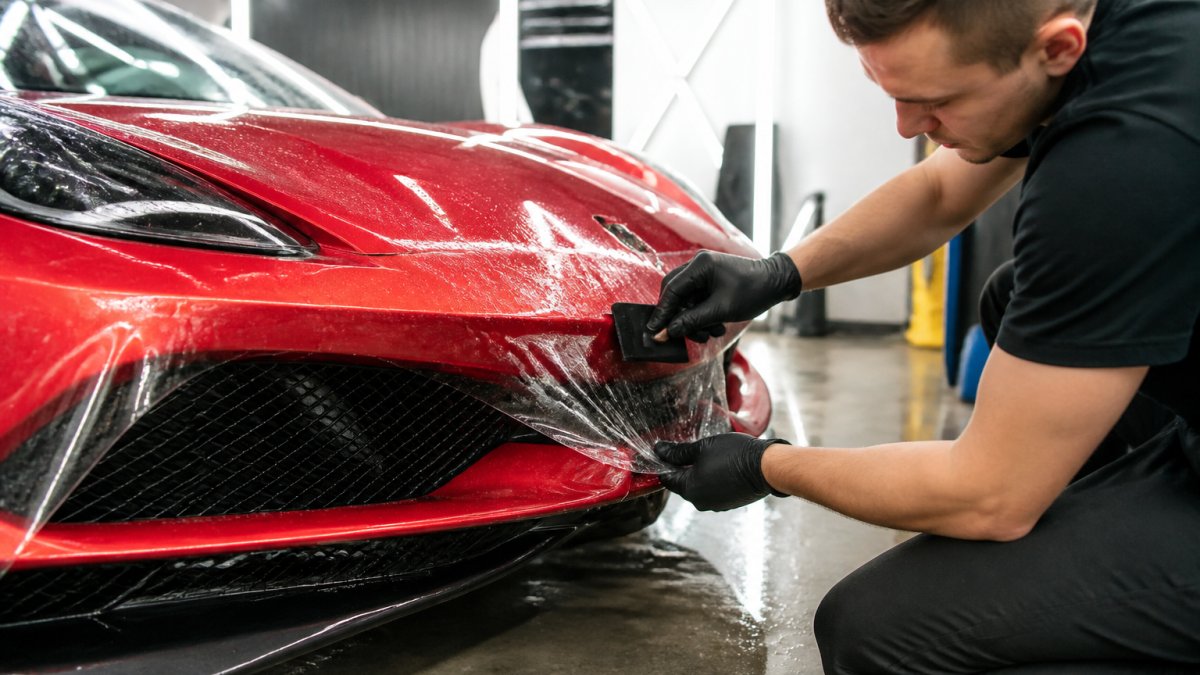
The real difference between a good install and a bad one comes down to pattern coverage and edge wrapping. A pre-cut kit that stops short of panel edges leaves a visible line and a dirt trap.
The High-Impact Zones on a Low-Slung Car
On a car with a low nose and wide fenders, damage concentrates in predictable places:
- Front bumper and lower fascia – first contact with gravel and road debris
- Leading edge of the hood – stone chips from highway traffic
- Side mirrors and A-pillars – chips thrown sideways at speed
A common mistake is protecting the hood and stopping there. On a low car, the rocker panels and rear fender flares take as much abuse as the nose, and they’re often the panels owners forget to cover.
Preserving Factory Paint and Resale Value
Factory paint is a one-time asset. You can protect it or lose it, and there is no way to put it back. That fact drives most of the resale argument for film, but on an exotic car the value mechanics are more specific than “original paint is better.”
How Paint Condition Shows Up in an Exotic Car Sale
On collectible and exotic vehicles, originality carries real weight, and the evidence buyers use is concrete:
- Paint depth readings. A specialist inspector runs a paint depth gauge across every panel. Consistent readings suggest factory finish; a panel that reads noticeably thicker or thinner than its neighbors suggests bodywork or a repaint.
- Panel-to-panel match. Metallics, pearls, and multi-stage factory colors are difficult to blend invisibly. A repainted bumper that does not match under sunlight or inspection lighting is a negotiating point.
- Repaint history. A documented repaint is not automatically disqualifying, but an undocumented one is. Buyers and inspectors treat unexplained paintwork as a risk premium.
Paint condition affects both the pool of interested buyers and the final negotiated price. A car with untouched factory paint and a clean inspection report attracts buyers who want originality; a car with a repainted nose attracts buyers who will discount for it. The exact dollar effect varies by marque, model, color, and documentation, so treat any specific percentage claim with skepticism unless it is tied to a documented sale.
The strongest value case for PPF is not the film itself. It is that original paint stays original, and originality is what buyers and inspectors pay for on a collectible car.
UV Exposure and Long-Term Paint Degradation
UV exposure matters here too. Long-term sun exposure fades and oxidizes unprotected paint, and on a car stored outdoors or driven regularly, that degradation is cumulative. Clear coat failure on a exotic car is expensive to correct because a proper repair often means repainting an entire panel or blending into adjacent panels to preserve a match. Quality film blocks most UV transmission, which slows fading on the panels it covers.
What Film Does Not Do for Value
Film protects the paint that is there; it does not create originality. A car with a prior repaint does not become original because film was applied over it. Film also does not replace documentation. Keep records of the installation date, film line, coverage plan, and any warranty, because a buyer or inspector will ask. The value argument is strongest when the film is part of a coherent ownership record, not a standalone receipt.
How Long Does PPF Last on an Exotic Car?
How long does PPF last? A professionally installed quality film typically lasts 5 to 10 years, depending on film grade, sun exposure, and how the car is washed and stored.
Two factors shorten film life faster than anything else:
- Abrasive washing. Brush tunnels and dirty mitts grind grit into the film surface, dulling the gloss and creating swirl marks in the top coat.
- Neglected edges. Film that lifts at an edge traps dirt and water, and once contamination gets under the film, the section has to be replaced.
The yellowing concern owners raise is legitimate for older or cheap film. Modern top-coated films resist yellowing, but the film brand and the installer’s storage and handling matter. Ask what film line is being used and how it’s warrantied before you commit.
Paint Protection Film vs Ceramic Coating
Paint protection film vs ceramic coating is not a competition, because they solve different problems. PPF absorbs physical impact; ceramic coating adds a hydrophobic, gloss-enhancing layer that makes washing easier and repels water and contaminants. Film protects against chips. Coating protects against bonding dirt and water spotting.
| Factor | Paint Protection Film | Ceramic Coating |
|---|---|---|
| Primary job | Absorbs rock chips and scratches | Repels water and contaminants |
| Impact resistance | High | None |
| Self-healing | Yes, minor marks | No |
| Typical lifespan | 5-10 years | 1-5 years |
| Best for | Front ends, high-impact zones | Whole-body gloss and easy washing |
Pros of PPF: real impact protection, self-healing minor scratches, preserves original paint, removable.
Cons of PPF: higher upfront cost, visible edges if poorly installed, requires careful washing.
Pros of ceramic coating: enhances gloss, easier maintenance, lower entry cost.
Cons of ceramic coating: no chip protection, requires reapplication, won’t stop stone damage.
Can You Put Ceramic Coating Over PPF?
Yes. Ceramic coating can be applied over PPF, and many owners do exactly that to combine impact protection with easier washing and added gloss. The coating goes on top of the film, never underneath it.
This layered approach is what we recommend for PPF on exotic cars driven regularly in the Northeast, where road salt and gravel are a year-round reality. Film handles the impacts; coating handles the grime.
PPF Maintenance and Care for Collectible Cars
PPF maintenance and care comes down to three habits: wash gently, dry thoroughly, and deal with edge lifting early. Hand wash with a pH-neutral soap and a clean microfiber mitt, and skip the brush tunnel entirely. Dry with a plush microfiber towel or filtered blower to avoid water spots.
Never use a pressure washer at close range on film edges. A high-pressure jet directed at a lifted edge can force water underneath the film, and once that happens the section has to be removed and reinstalled.
Self-healing film recovers from light marks with heat, either from the sun or a warm water rinse. Deeper scratches that don’t disappear after warming are in the film, not the paint, which is the whole point. If a section is damaged beyond recovery, film can be removed and replaced panel by panel without touching the paint underneath, provided it was installed correctly.
Coverage Choices, Limitations, and Installation Risks
Coverage decisions should follow how you actually use the car, not a generic package name. A garage-kept weekend car that sees occasional canyon runs needs less than a daily commuter eating highway gravel, and a track car needs protection in places a show car does not.
Matching Coverage to Driving and Storage Habits
| Use pattern | Recommended coverage | Why |
|---|---|---|
| Garage-kept collector, low annual miles | Full front or high-impact package | Preserves the most visible and most chip-prone panels without covering the whole car |
| Regular touring and weekend drives | Full front plus rockers, mirrors, A-pillars, and rear haunches | Debris hits the nose first, but low cars also throw grit onto their own flanks |
| Daily highway commuting | Full front, A-pillars, mirrors, rocker panels, and rear bumper | Sustained highway exposure and road spray increase risk across more panels |
| Track and canyon use | Full front plus rockers, mirrors, rear haunches, and consideration of full-body | High speeds and close traffic raise impact energy and debris volume |
| Full-body coverage | Entire vehicle | Maximum protection and the cleanest visual result, at the highest cost and installation complexity |
Full-body coverage is the only option that protects every painted surface, but it is also the most expensive and most demanding install. On a complex exotic, a partial front that wraps every edge cleanly often looks better than a full-body job with visible seams and lifted edges.
Film Types and Finish Choices
Film is not one product. The main choices are:
- Gloss film. The default for most exotic cars. It preserves the factory look and is the easiest to match to original paint.
- Matte or satin film. Used to preserve or create a matte finish. It requires different washing habits and cannot be polished the way gloss film can.
- Colored film. Changes the vehicle’s appearance while protecting the paint underneath. It is a different product category from clear PPF and should be evaluated on its own warranty and removal characteristics.
Ask which film line is being installed, what warranty applies, and whether the finish matches the rest of the car. A gloss film on a matte-painted car, or the reverse, is a visible mistake.
Honest Limitations
Film will not prevent every impact. Deep dents still transfer through to the panel, and a sharp edge or heavy strike can damage film and paint together. Film can stain if contaminants sit on it, edges can lift if the install was rushed, and older or lower-grade film can yellow. None of these limitations make film a bad choice; they make it a product with a maintenance requirement.
Installation Risks on Complex Exotic Panels
On exotic cars with compound curves, multi-panel bumpers, tight shut lines, and sensors embedded in fascias, installation skill matters more than film brand. The main risks are:
- Inadequate paint inspection before install. Film should not go over fresh paint, failing clear coat, or prior bodywork without assessment. Trapping a problem under film makes it worse.
- Poor prep. Contamination under the film shows as bumps and can cause adhesion failure.
- Unwrapped edges. A pre-cut kit that stops short of panel edges leaves a visible line and a dirt trap.
Ask to see completed work on a comparable car, and ask how the installer handles wrapped edges, seams, and sensors on your specific model. On exotic cars, that conversation tells you more than the film brand alone.
At 203wraps, our certified technicians specialize in high-end and collectible automobiles, and we treat every install as a long-term commitment to the car’s finish.
Frequently Asked Questions
What are the benefits of PPF on exotic cars?
PPF on exotic cars shields the factory paint from rock chips, road debris, scratches, and UV fading while keeping the original finish intact. Because a clear film absorbs impacts that would otherwise pit or crack the paint, it protects both appearance and resale value. It is also removable, so the paint underneath stays original, which matters to collectors and buyers who check for resprays.
How long does PPF last on an exotic car?
Most quality paint protection film lasts five to ten years depending on film grade, sun exposure, and how the car is stored and washed. Garage-kept exotics that see occasional weekend drives usually sit at the longer end. Film on a daily-driven car parked outside will age faster. Have the film inspected annually, and replace any section that lifts, yellows, or stops self-healing.
Does PPF protect exotic car paint from rock chips and scratches?
Yes. PPF rock chip protection comes from a flexible urethane layer that absorbs the energy of stones, gravel, and road debris before it reaches the paint. It also takes the hit from minor scratches, scuffs, and swirl marks, and many films self-heal light marks with heat. It will not stop a deep gouge or a collision, but it handles the everyday hazards that damage low front ends.
Can you put ceramic coating over PPF?
Yes, and many owners do. Ceramic coating over PPF adds slickness and makes washing easier, but it does not replace the film’s impact protection. Apply the coating after the film has fully cured, following the film maker’s guidance. The two work as layers: PPF absorbs physical damage, ceramic coating handles water, dirt, and UV on the surface.
Protecting an exotic car’s paint is a decision you make once and live with for years. The wrong film or a rushed install costs more to fix than doing it right the first time. 203wraps brings over a decade of experience, certified technicians, and a specialization in high-end and collectible automobiles to every install, with clean edges and premium finishes as the standard. Book now with 203wraps and protect the finish your car was built with.
