
Table of Contents
- Paint Protection Film vs Ceramic Coating: How They Differ
- PPF vs Ceramic Coating Cost: What You’re Actually Paying For
- How Long Does PPF Last Compared to Ceramic Coating?
- Protection Compared: Rock Chips, Scratches, and Environmental Damage
- PPF Maintenance: What It Takes to Keep the Film Performing
- Can You Apply Ceramic Coating Over PPF?
- Which Is Better for Your Car? A Decision Framework
- Frequently Asked Questions
Last Updated: October 7, 2026
Paint Protection Film vs Ceramic Coating: How They Differ
Paint protection film vs ceramic coating comes down to one distinction: PPF is a thick, transparent urethane film that absorbs physical impacts, while ceramic coating is a thin liquid polymer that bonds to your clear coat and repels water, chemicals, and UV rays.
The confusion starts because both are marketed as “paint protection.” They aren’t competing products so much as different layers of defense. PPF is armor. Ceramic coating is a raincoat.
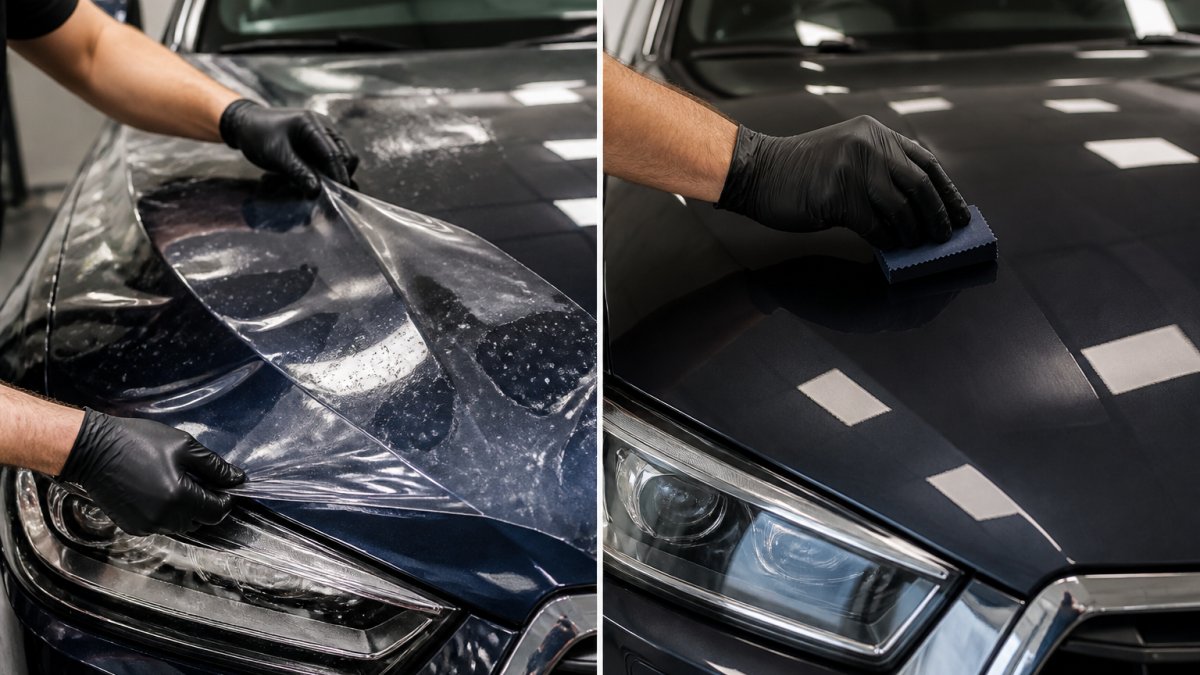
PPF stops physical damage. Ceramic coating resists environmental and chemical damage. Neither replaces the other, and the best setups use both.
PPF vs Ceramic Coating Cost: What You’re Actually Paying For
Most articles dodge the price question or quote a national average that has nothing to do with your car.
What actually drives the price
- Coverage area. PPF is priced by panel. A partial front (bumper + partial hood + mirrors) covers the highest-impact zone. A full front adds full hood, full fenders, and headlights. A track pack adds rocker panels and rear bumper impact areas. Full body covers every painted panel.
- Film tier. Entry-level film, mid-tier film with a self-healing top coat, and premium film with a thicker clear coat and longer warranty are three price points. Thicker film costs more in material and labor, it’s less forgiving to install.
- Coating tier. Consumer-grade, professional-grade, and multi-layer professional systems sit at very different price points. The jump from consumer to professional multi-layer is mostly labor and prep, not material.
- Paint correction hours. This is the variable most quotes hide. A new car with flawless paint needs light decontamination and a single-stage polish. A five-year-old daily driver with swirl marks, water spots, and light etching may need two or three stages. Billed by the hour, correction can rival the coating cost itself.
- Local labor rates. Installation labor varies by market. A dense metro area with high overhead quotes higher than a smaller market for the same job.
Initial cost vs. long-term ownership cost
The sticker price is only half the math. PPF is a one-time purchase with a defined lifespan, when it fails, you replace it.
That reframes the comparison. Keep the car three years and the coating’s recurring cost barely matters. Keep it eight and the film’s replacement cost enters the picture while the coating’s annual maintenance adds up.
| Factor | PPF | Ceramic Coating |
|---|---|---|
| Material | Urethane film, 6-8 mils | Liquid polymer, microns |
| Main cost driver | Film coverage + install labor | Paint prep + correction hours |
| Coverage options | Partial front, full front, track pack, full body | Whole vehicle, wheels, glass, trim |
| Recurring cost | Removal + reinstall at end of life | Annual maintenance/inspection to keep warranty |
| DIY feasibility | Not realistic | Possible but risky |
How to compare quotes fairly
Ask each installer to itemize: brand and tier, exact panels covered, correction stages included, and whether the warranty requires paid annual service. Two quotes for “full front PPF” can differ by hundreds because one includes paint correction and one doesn’t.
The most common mistake we see is skipping paint correction before a ceramic coating. If your clear coat has swirl marks, etching, or oxidation, the coating seals them in and you’ll see every defect through the gloss for years. Correction is not an upsell, it’s the difference between a coating that looks good and one that magnifies every flaw.
For current pricing on your specific vehicle, request a quote from our team. Pricing depends on your panels, your paint’s condition, and how much of the car you want covered.
How Long Does PPF Last Compared to Ceramic Coating?
How long does PPF last? A quality film installed by a certified technician typically lasts many years, and top-tier films carry manufacturer warranties that reflect that lifespan. Ceramic coatings generally last a shorter span, with entry-level products fading well before premium ones.
What actually determines lifespan
- Climate. A car parked outdoors in a high-UV, high-heat climate ages film and coating faster than a garaged car in a mild climate. UV breaks down the top coat on film and the polymer matrix on coating. This is the single biggest environmental variable.
- Mileage and exposure. A daily highway commuter accumulates impact and contamination a weekend garage-kept car never sees: more rock chips on film, more bug splatter, salt, and tar on coating.
- Washing habits. Automatic brush washes grind grit into both surfaces and are the fastest way to shorten either product’s life. Hand washing with a pH-neutral soap and proper technique is the baseline for getting the full lifespan.
- Installation quality. Film stretched too thin, applied over contamination, or left with lifted edges fails early regardless of brand. Coating applied over uncorrected paint or in a humid, uncontrolled environment can fail to bond. Installation quality often matters more than product tier.
- Paint condition at install. Film and coating both bond to what’s underneath. Failing clear coat, oxidation, or previous coating layers can cause adhesion problems that shorten lifespan.
Warranty mechanics, what’s actually covered
Warranties vary widely, and the fine print matters more than the headline term. A film warranty typically covers yellowing, cracking, bubbling, and delamination, but excludes accidents, improper washing, or road hazards.
Three questions to ask before you commit:
- Does the warranty cover labor, or only the material?
- Does it require paid annual inspections or maintenance services?
- Is the warranty backed by the manufacturer, the installer, or both?
A warranty that excludes labor or requires paid annual inspections isn’t the same as one covering film failure outright. Read the terms, not the marketing.
Failure modes to expect
Neither product lasts forever, and knowing how each one fails helps you plan.
- Film yellowing. Older or lower-tier film can yellow over time, especially on white and light cars. Premium films with better UV inhibitors resist longer.
- Edge lifting and seams. Film edges collect dirt, and grit worked under an edge is how peeling starts. Seams on complex panels are normal and not a defect.
- Coating water spots. A coated surface still gets water spots if hard water sits and evaporates. The coating makes them easier to remove, not impossible.
- Coating abrasion limits. Coating is measured in microns. It resists wash-induced swirls but does nothing against a rock chip or a shopping cart. It is not a substitute for film on impact zones.
If you drive through winter salt, rinse the lower panels and wheel arches weekly. Salt spray sits on film edges and accelerates lift, which is the failure mode we see most often on daily drivers.
The realistic takeaway
Expect film to outlast coating in most real-world conditions, but both fall short of maximum lifespan if the car is parked outdoors, driven hard, or washed carelessly.
Protection Compared: Rock Chips, Scratches, and Environmental Damage
Rock chips and road debris are where PPF has no competition. The urethane layer absorbs stone impacts that would otherwise chip your clear coat and primer. On a highway commute with gravel trucks and winter salt spray, that impact resistance is the entire point.
Scratch and swirl-mark resistance works differently for each product. PPF’s self-healing top coat lets light abrasion vanish with heat, whether from sun or warm water.
Environmental and chemical damage is ceramic coating’s home turf. Its hydrophobic surface makes water bead and roll off, meaning fewer water spots and less mineral etching.
Dirt repellency and ease of cleaning improve with both. PPF gives a smooth, uniform surface that sheds grime; ceramic coating on top makes washing faster and less frequent.
American Chemical Society overview of polymer degradation
PPF Maintenance: What It Takes to Keep the Film Performing
PPF maintenance is simpler than most owners expect, but it isn’t nothing. Treat the film like paint: wash it regularly, avoid abrasive products, and address contamination early.
A routine that works:
- Hand wash every two to four weeks with a pH-neutral soap
- Remove bug splatter and bird droppings promptly, since acids etch
- Skip automatic brush washes entirely
- Apply a ceramic coating or sealant over the film to boost hydrophobics
- Inspect edges and seams seasonally for lift
Wash maintenance matters more than most people think. Film edges collect dirt, and grit worked under an edge starts peeling. A soft wash mitt, two buckets, and care around the seams will add years.
Can You Apply Ceramic Coating Over PPF?
Yes, and for many owners this is the best of both worlds. Ceramic coating over PPF gives you the film’s impact resistance plus the coating’s hydrophobic behavior, easier cleaning, and deeper gloss.
The catch: not every coating bonds properly to film. Some formulas are designed for paint and bead up or fail on urethane. Your installer needs a film-compatible coating and must let the film fully cure first, days, not hours.
This combined approach is what we recommend for high-end and collectible vehicles. The film takes rock chips and stone impacts; the coating handles water beading, chemical contaminants, and wash maintenance. You get gloss, paint clarity, and a surface that stays cleaner between washes.
One honest limitation: stacking both adds cost and won’t fix bad paint underneath. If your clear coat is already failing, no film or coating will hide it.
Which Is Better for Your Car? A Decision Framework
Neither product is universally better. The right choice depends on how you drive, where you park, and how long you plan to keep the car.
- If you commute on highways with gravel and salt: PPF first, at minimum full-front coverage.
- If you park outdoors or live near trees: Ceramic coating first for chemical and UV resistance.
- If you own a collectible or exotic: Both, with film on impact zones and coating over the whole car.
- If you’re leasing or selling soon: Ceramic coating alone, since film is a bigger commitment.
- If your paint already has swirls or etching: Paint correction before either product. Always.
Coverage planning should follow your driving conditions, not a package menu. A garaged weekend car needs less film than a daily commuter eating I-95 gravel, so we build every quote around your actual panels and exposure.
Federal Trade Commission guidance on advertising claims
Society of Automotive Engineers technical standards
Choosing between these two products isn’t really a choice once you understand what each does. The challenge is finding an installer who gets the preparation right, because film and coating both fail on bad paint and rushed work. 203wraps has spent over a decade installing PPF and ceramic coating on high-end and collectible vehicles, with certified technicians, film-compatible coating systems, and a commitment to clean installs and premium finishes. Book now with 203wraps and protect the finish your car deserves.
Frequently Asked Questions
Can I take a car with PPF through a car wash?
Touchless car washes are generally safe for paint protection film, but brush-style washes can catch film edges and cause lifting. Hand washing with pH-neutral soap is the safest method. If you must use an automated wash, choose one that is brushless and confirm the film edges are fully sealed. Proper PPF maintenance includes avoiding high-pressure sprays directed at seams, which helps the film stay bonded and clear for years.
Does ceramic coating protect against rock chips?
No. Ceramic coating is a thin, chemical-resistant layer that repels water, dirt, and UV rays, but it cannot absorb the kinetic energy of a rock chip or stone impact. Paint protection film, typically 8 mils thick, is designed specifically to absorb those impacts. For full protection against road debris, PPF is the necessary layer. Ceramic coating over PPF adds hydrophobic and easy-cleaning benefits on top of that physical barrier.
Which is better for a new car: PPF or ceramic coating?
For a new car, paint protection film offers the most comprehensive protection because it guards against the physical damage that cannot be polished out, like rock chips and scratches. Ceramic coating protects against environmental damage and makes washing easier but does not stop impacts. Many owners choose both: PPF on high-impact areas and ceramic coating over the entire vehicle. The best choice depends on your driving conditions and how you plan to use the car.
How long do PPF and ceramic coating last?
Quality paint protection film typically lasts 5 to 10 years depending on the product and installation quality, with some premium films warrantied for up to 10 years. Ceramic coatings generally last 2 to 5 years, with professional-grade options reaching the higher end when properly maintained. PPF lifespan is influenced by sun exposure, washing habits, and whether the film is self-healing. Ceramic coating durability depends on the number of layers and the environment the car faces.