
Last Updated: November 1, 2026
Quick Summary
Yes, tinting does affect night driving visibility, but film quality matters more than shade. A cheap dyed film at a light shade can blur headlights worse than a premium ceramic film at a darker shade. Film type, glass quality, and installation decide whether you see clearly or squint.
- VLT is the percentage of visible light that passes through a window film.
- Factory glass usually runs 70% to 80% VLT before any film is applied.
- Combined VLT multiplies glass VLT by film VLT rather than adding them.
- The best night setup is ceramic film at 35% to 50% VLT on front-side windows.
- If you cannot read a license plate two car lengths ahead at night, the tint is too dark.
Table of Contents
- How Window Tint Changes What You See After Dark
- Window Tint VLT and Visibility: The Number That Decides Everything
- How to Tell If Window Tint Is Too Dark
- Ceramic Window Tint Visibility at Night: Why Film Type Matters
- The Best Window Tint for Night Driving by Shade and Driving Condition
- Rain, Glare, and Poorly Lit Roads: Real Low-Light Conditions
- Front, Rear, and Windshield Tint: Where Visibility Is Won or Lost
- Legal Tint Limits and How to Verify the Rules That Apply to You
- Frequently Asked Questions
How Window Tint Changes What You See After Dark
Yes, tinting does affect night driving visibility, but the effect depends far more on film quality than most drivers expect. Customers often worry about seeing the road after sunset.
Film darkness is only half the story. A cheap dyed film at a light shade can blur headlights worse than a premium ceramic film at a darker shade.
Below, we cover how tint changes what you see after dark, how to read VLT numbers, and how to pick a safe shade for poorly lit roads. To see the shop’s window tint service and options, visit the window tint page.
Window Tint VLT and Visibility: The Number That Decides Everything
Visible light transmission (VLT) is the percentage of visible light that passes through a window film. A 35% VLT film lets roughly 35% of outside light into the cabin.
That number drives your night driving visibility more than any other spec: lower VLT means a darker cabin and less light reaching your eyes; higher VLT means a brighter view and less privacy.
Shade labels map directly to VLT:
- 50% VLT: light tint, close to clear, strong night visibility
- 35% VLT: the common factory-match shade, moderate privacy
- 20% VLT: dark, noticeable privacy, dimmer at night
For a deeper look at one popular shade, this breakdown of whether 35% tint is dark enough for privacy covers the trade-offs.
Why Factory Glass Already Has a VLT
No car window starts at 100% VLT. Factory glass carries a slight tint of its own, usually 70% to 80%, and privacy glass in the rear often sits lower.
So you never get the film’s rated VLT on its own, the glass is already filtering light before the film goes on.
How Combined VLT Works on Your Car
Combined VLT is the real number your eyes experience. It multiplies the glass VLT by the film VLT, not adds them.
Here is the math in plain terms:
- Factory glass at 70% VLT plus a 50% film lands near 35% combined
- Factory glass at 70% VLT plus a 35% film lands near 25% combined
- Factory glass at 70% VLT plus a 20% film lands near 14% combined
So a “35% tint” on paper can behave like a 25% window in practice, which is why two cars with the same film label can feel completely different at night.
How to Tell If Window Tint Is Too Dark
The clearest test: if you cannot read a license plate two car lengths ahead through your side window at night, the tint is too dark for that glass. Your eyes should adjust within seconds, not strain for the whole drive.
Watch for these warning signs:
- Headlights from oncoming cars smear into a wide blur
- You lose the road edge on unlit streets
- You lean forward to see the dashboard or mirrors
A common mistake is judging tint in a bright shop bay. Ask to sit in the car at dusk or after dark before you commit, a shade that looks refined in daylight can feel claustrophobic on a rural road.
Ceramic Window Tint Visibility at Night: Why Film Type Matters
Film type changes night driving visibility as much as shade does. Selecting a high-quality film is only the first step, as maintaining clean glass and proper headlight alignment are equally vital to improve night driving visibility.
Here is how the main types compare after dark:
- Ceramic film: sharp optics, low haze, strong heat rejection, best clarity per shade
- Carbon film: good clarity, matte finish, solid mid-range option
- Dyed film: cheaper, prone to fading and haze, weakest night clarity
The difference shows most in glare: ceramic film handles headlight and mirror glare better because it filters selectively rather than just dimming everything. If you are weighing premium film, this guide on whether professional window tinting is worth it lays out the value case.
The Best Window Tint for Night Driving by Shade and Driving Condition
The best window tint for night driving is a ceramic film in the 35% to 50% VLT range on front-side windows, paired with a darker shade on the rear glass.
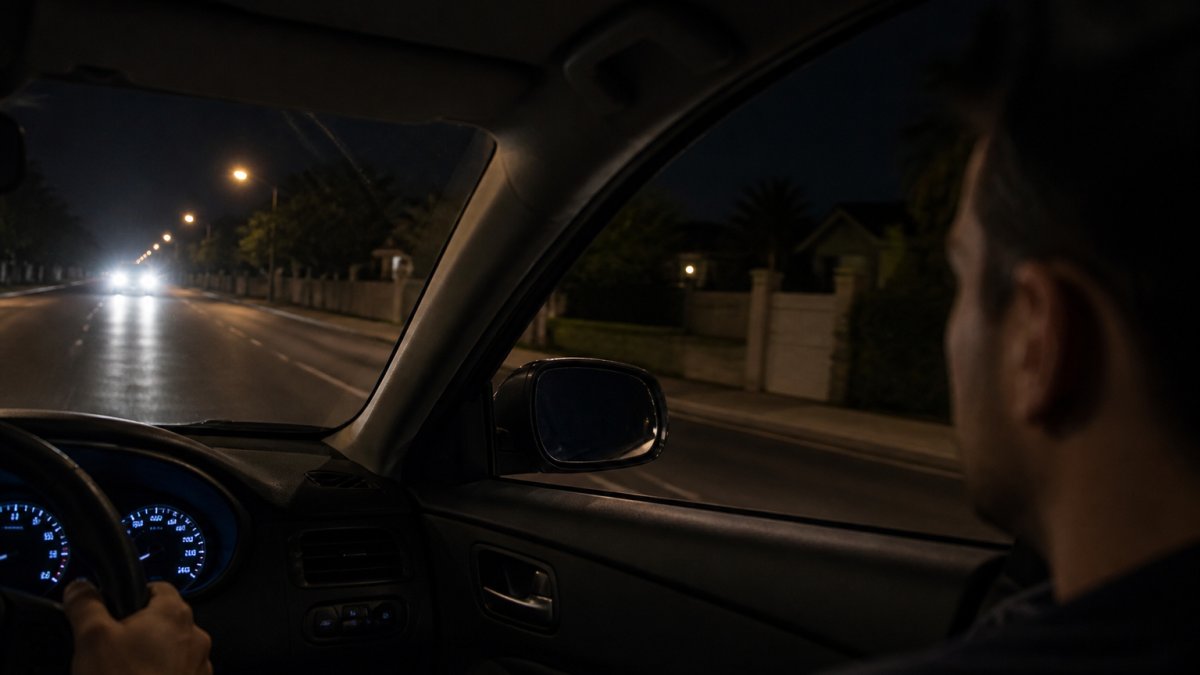
Match the shade to how and where you drive:
| Driving condition | Recommended front VLT | Why it works |
|---|---|---|
| City streets, well lit | 35% | Balances privacy and clear side vision |
| Highway commuting | 35-50% | Keeps lane markings and signs sharp |
| Rural, poorly lit roads | 50% | Maximum light for the driver’s eyes |
| Rain and fog driving | 50% | Less dimming when contrast drops |
| Rear passenger glass | 20-35% | Privacy without affecting your view |
For a daily commuter facing salt spray and gravel, a lighter front shade with a darker rear shade is a common choice. There is no universal right answer, only the right answer for your roads.
Test Night Visibility Before You Commit to a Shade
Shade charts tell you what a film is rated to do, not what your eyes will see through your specific glass on your specific roads. Before you sign off, run a short, repeatable test in a safe, familiar setting, the step most buyers skip, and the one that prevents an expensive re-tint.
- Pick a familiar low-light loop. Choose a route you know well that includes a lit parking lot, an unlit residential street, and a stop sign or intersection. Drive it once in daylight so you know the landmarks, then again after dusk.
- Check the road edge and lane markings. At 25 to 35 mph on the unlit stretch, can you see the white edge line and the center line without leaning forward? If either disappears, the shade is too dark for that glass.
- Read a plate at two car lengths. Park behind a stationary car in the lot and confirm you can read its license plate through the front-side window at roughly two car lengths. This is a practical proxy for resolving detail at distance.
- Test the mirrors, not just the windshield. Back into a space and check whether the side mirrors and rearview mirror show clear edges of the space and any nearby objects. Rear glass can be darker, but the mirrors still need to resolve shape and distance.
- Watch oncoming headlights. Have a helper hold a bright light or drive toward you in the lot. You want a defined source with a controlled halo, not a wide smear that washes out the lane.
- Check the dashboard reflection. At night the dash glow can bounce off the inside of the glass. Confirm the reflection does not sit over your view of the road edge.
- Repeat in light rain if you can. A damp windshield and wet asphalt cut contrast. If the view is marginal when dry, it will be worse when wet.
Judge the film on clean glass. Dust, fingerprints, and road film can make a 50% film feel like a 20% film. Wipe the inside and outside of the window before you evaluate, and evaluate at the same time of night for a fair comparison.
Verify the Combined VLT, Not Just the Film Label
The number on the film box is not the number your eyes get, since factory glass already filters light. Ask the installer for the film’s VLT and confirm the combined figure against your state’s limit. A handheld transmission meter gives a real reading on the installed window.
Choose by Window, Not by Whole-Car Shade
Front-side windows do the most work for your night view, so keep them light. Rear glass can go darker because it affects your rearward view through the mirror more than your direct sightline. The windshield is the most restricted and most consequential pane at night, so follow your state’s rules and avoid adding film unless it is legal and you have tested the result.
Rain, Glare, and Poorly Lit Roads: Real Low-Light Conditions
Real low-light conditions stack problems. Rain scatters light and cuts contrast, wet asphalt swallows headlight beams, and dirty or scratched glass turns every oncoming light into a smear. Tint does not create these problems but can amplify them: each hazard removes light or adds stray light, and a darker window removes more of the light your eyes need to separate road from everything else.
How the Hazards Interact
- Rain plus tint. Water on the glass and wet pavement both reduce contrast. A film that is fine on a dry night can feel marginal in rain because the film is already cutting the light that would otherwise help you pick out lane markings.
- Glare plus tint. Headlight glare is worst when the source is bright and the background is dark. A quality ceramic film can knock down the peak of oncoming and mirror glare, but a hazy or scratched film spreads that glare into a wide veil that is harder to see through than the original light.
- Dirty or scratched glass plus tint. Grime and fine scratches scatter light. On a tinted window, that scatter is more noticeable because there is less light to spare. Treat a scratch on a tinted pane as a visibility issue, not a cosmetic one.
Practical Countermeasures
- Keep the glass genuinely clean. Clean the inside and outside of every tinted pane, and clean the wiper blades. A dirty windshield behind a light film can feel darker than a clean windshield behind a slightly darker film.
- Replace worn wipers and top off washer fluid. Streaking wipers turn rain into a smear that tint makes harder to see through. Fresh blades and a full reservoir are cheap insurance.
- Use low beams in rain and fog. High beams bounce off rain and fog and make glare worse. Low beams keep the light where it helps.
- Dim the dashboard. A bright dash at night reflects in the glass and competes with the road view. Turn the interior brightness down to the lowest comfortable setting.
- Address scratches and haze early. If a tinted pane looks hazy or shows fine scratches in low light, have it inspected. Haze and distortion are film or installation problems, not a normal consequence of tint, and they can often be corrected.
- Slow down and increase following distance. Tint does not change stopping distance, but reduced contrast does change how soon you see a hazard. More space buys time.
Never judge a film’s night performance through a dirty window. Clean the glass first, then evaluate. Grime alone can make a light tint feel dangerously dark, and it can also mask a real film defect.
Glare is the flip side of darkness. Headlight and mirror glare from cars behind you can blind a driver at night, and a quality ceramic film cuts that glare without turning the cabin into a cave. Choose a film that reduces the harsh peak of bright lights while still letting enough ambient light through to read the road. If glare is your main complaint, address it with film quality and a light front shade rather than going darker, because a darker film reduces ambient light without necessarily fixing the glare source.
Front, Rear, and Windshield Tint: Where Visibility Is Won or Lost
Visibility is won or lost at the front-side windows and the windshield. Those are the panes your eyes rely on most for lane position, road edges, and peripheral vision at intersections.
Rear windows matter far less for your forward view, which is why you can go darker there. Windshield tint is its own category. Most states restrict it heavily, and a tinted windshield at night is the fastest way to ruin your view, especially in rain.
Front-side windows carry the biggest trade-off because they frame your peripheral vision, so a dark shade there hurts more than the same shade on rear glass. For owners protecting the interior from sun damage, this look at how professional tint prevents interior fading explains why rear and side coverage still pays off.
Legal Tint Limits and How to Verify the Rules That Apply to You
Legal tint limits are set state by state, and they vary. Some states allow dark film on rear glass but restrict front-side windows. Others cap everything at a lighter shade.
Do not trust a shop’s generic chart or a forum post. Verify the rules yourself:
- Check your state’s motor vehicle department website for current VLT limits
- Confirm whether rules differ for front-side, rear-side, and windshield glass
- Note any medical exemption process if you need darker film
State rules change, and enforcement varies by area. The Insurance Institute for Highway Safety tracks highway safety research, and your state motor vehicle agency is the final word on what is legal where you drive.
If night driving visibility is your priority, the safest plan is a light ceramic film up front and a darker shade behind. It protects your view, cuts glare, and keeps you legal.
Frequently Asked Questions
How can I tell if my window tint is too dark for night driving?
Test it on a road you know after sunset. If lane markings, curbs, and pedestrians at the edge of your headlights look dim or slow to resolve, the shade is too dark for your eyes and your driving environment. Check the film’s VLT rating against your state’s legal limit for front-side windows, and look through the glass from inside the cabin at dusk before committing. A film that reads fine in daylight can still cost you peripheral vision once light drops.
Does ceramic window tint reduce visibility at night?
Ceramic film reduces visibility only through its VLT, the same as any other film. What sets ceramic apart is clarity: it avoids the haze and slight distortion that cheaper dyed films can introduce, and it blocks more infrared heat without needing a darker shade. That means you can often choose a lighter ceramic film and still get the heat rejection you want, which helps preserve night driving visibility.
Which windows affect night driving visibility the most when tinted?
The front-side windows matter most, because that is where your peripheral vision and mirror checks happen. Windshields are restricted by law in every state and should never be darkened beyond what the rules allow. Rear windows affect what you see in the mirror, and a very dark rear film can make headlights behind you harder to judge. Many drivers keep the front lighter and go darker toward the back.
How can I reduce headlight glare at night without making visibility worse?
Choose a quality film with good optical clarity and a moderate VLT rather than a very dark shade. Ceramic films cut infrared heat and can take the edge off glare without turning the cabin into a cave. Keep the glass clean inside and out, since smudges and scratches scatter light and make glare worse. If glare is your main complaint, address it with film quality and windshield condition before reaching for a darker tint.
Night driving does not have to be a compromise between style and safety. At 203wraps, our certified technicians help you pick a shade and film type that fits your roads, your car, and your state’s rules. We bring over a decade of experience with high-end and collectible automobiles, a commitment to clean installs, and premium finishes that hold up. Get started with 203wraps and drive after dark with confidence.
